
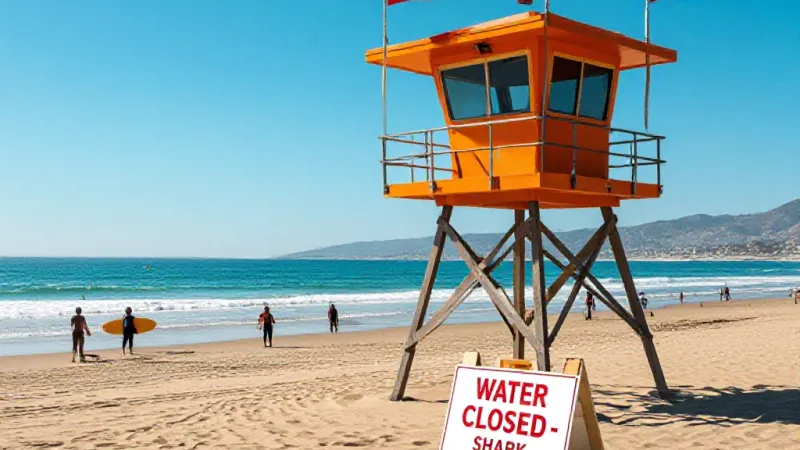
An "aggressive" great white shark was reported in the waters off Huntington Beach on Tuesday, prompting officials to close a significant portion of the coastline to water activities. The Huntington Beach Fire Department stated Tuesday afternoon that a roughly 10- to 12-foot great white shark exhibiting "aggressive behavior" was seen near Lifeguard Tower 16.
Derek Peters, marine safety battalion chief with the department, said the closure followed a report received around 3 p.m. from a foilboard surfer. The surfer observed the shark circling approximately 300 feet offshore. Peters confirmed that the surfer was not bumped, bitten, or otherwise harmed by the animal.
Despite conducting searches by drone, jet ski, rescue boat, and through beach patrols, the department was unable to independently verify the shark sighting. However, officials deemed the surfer who made the report a "credible source," leading to the decision to close the water. The affected area spans from Seapoint Street to the Huntington Beach Pier, covering a roughly two-mile stretch of water.
The closure is expected to remain in effect through 3 p.m. Wednesday, with additional patrols planned before the waters are reopened. While residents and visitors are permitted to remain on the sand, they are strongly advised to stay out of the water for their safety.
Chris Lowe, director of the Cal State Long Beach Shark Lab, posited that the spotted great white was likely an adult, potentially hunting for elephant seals in the area. Lowe indicated that his researchers intend to deploy drones and other tracking methods to the location on Wednesday to try to confirm the sighting.
Peters noted that the Huntington Beach area typically experiences an increase in shark sightings during the fall and spring seasons, aligning with migratory patterns. This incident marks the second shark-related water closure for Huntington Beach this year; a previous sighting near the pier in the spring also resulted in a 24-hour closure.
Lowe further explained a broader trend of surging shark sightings at Southern California beaches this year. Experts attribute this uptick to El Niño, a climate pattern characterized by warmer ocean waters in the central and eastern tropical Pacific. The region's ocean temperatures have recently been at levels favorable to juvenile white sharks, typically 5 to 10 feet in size. Historically, these juvenile sharks would congregate near Baja, Mexico, at this time of year, but increasingly warm ocean temperatures there are prompting them to head north. Lowe also noted the frequent presence of sharks in the ocean, even when unobserved by beachgoers.