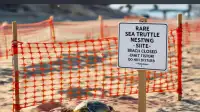

Orange County recently witnessed an unprecedented natural event as olive ridley sea turtles nested on its beaches for the first time on record. These historic appearances mark the first known natural sea turtle nests on the U.S. West Coast.
The initial sighting occurred on September 16, when a turtle emerged from the sea onto a patch of sand on Surfside Avenue in Seal Beach. The olive ridley sea turtle dug a pit, deposited a clutch of eggs, and then returned to the ocean, leaving lifeguards surprised.
Just three days later, a second turtle sighting took place about eight miles down the beach, south of Tower 15 in Huntington Beach. Another olive ridley clambered ashore, cleared a hole, laid her eggs, and slipped back into the ocean.
These nesting events have surprised experts, even in an era of regular climate-related changes. Lindsey Peavey Reeves, a senior scientist with the National Marine Sanctuary Foundation who has studied olive ridleys in the eastern Pacific Ocean for two decades, stated she had been expecting to see subtropical species off Southern California during El Niños, but not nesting in Orange County.
Olive ridley sea turtles are typically found in tropical regions of the Pacific, Indian, and Atlantic oceans, with significant nesting populations in Mexico, Nicaragua, Costa Rica, and Panama. Before last week, the farthest known northern nesting ground was in the Mexican state of Baja California Sur, according to Peavey Reeves.
Upon receiving reports of the turtle sightings, the Huntington Beach Fire Department Marine Safety team contacted the National Oceanic and Atmospheric Administration (NOAA) and the U.S. Fish and Wildlife Service. Wildlife officials quickly responded by erecting small mesh huts around each nest. A wider cordon has been established at both sites to keep the public at a safe distance. NOAA confirmed that the nests will remain fenced and monitored throughout the typical incubation period of 45 to 60 days.
After incubation, the hatchlings are expected to crawl to the ocean, becoming the first known sea turtles to begin their lives in California waters. The olive ridley is among the smaller sea turtle species, growing up to 3 feet long and weighing around 100 pounds, identifiable by its heart-shaped, olive-colored shell. While listed as a threatened animal under the Endangered Species Act, it is considered one of the more abundant sea turtle species.
Peavey Reeves noted that while this nesting event was unexpected, it is not outlandish for olive ridley nesting to shift northward as ocean water temperatures and sand temperatures increase, and as some traditional nesting beaches erode during strong storms. She added that olive ridleys are just one of many species globally shifting habitats as oceans warm and the climate changes. An extreme marine heat wave and the latest El Niño, predicted to be one of the strongest ever recorded in California, have disrupted marine and terrestrial life. The global average sea-surface temperature on August 22 measured a record-breaking 70 degrees, the highest recorded since March 2024.
It remains uncertain what the survival rates will be for the hatchlings that reach the ocean, as early life survival is very low for all sea turtle species. It is also unclear whether these nesting events are a one-off occurrence or if Orange County beaches might see more nests in future seasons. Olive ridleys are known for their adaptability, laying eggs both in vast colonies—such as one nesting beach in La Escobilla, Mexico, which hosts an estimated 450,000 nesting female turtles, according to NOAA—and in solitary locales.
Pamela Plotkin, a retired oceanography professor at Texas A&M University, described them as "very flexible and adaptable," noting their ability to "go with the flow" and take advantage of opportunities that other sea turtles cannot, such as feeding on diverse deep-water foods. Plotkin suggested that time will tell if these are the first of many such nesting events in California or simply isolated incidents.