California faces a dual challenge and opportunity this fall and winter with a strong El Niño increasing the odds of major storms. While the state is on alert for potential flooding, these events also present a significant chance to boost critical water reserves.
Experts indicate that California has made progress in capturing stormwater, though they suggest more efforts are still possible to capitalize on an extremely wet year.
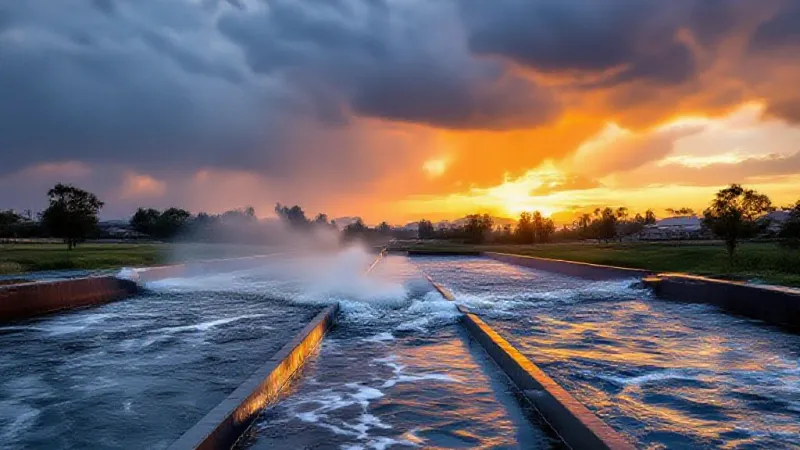
In Los Angeles County, the Public Works Department operates a network of 27 spreading grounds. These artificial basins fill as storms send torrents from the mountains into the San Fernando and San Gabriel valleys. The water then sinks into porous soil, replenishing groundwater. Sterling Klippel, assistant deputy director of the L.A. County Public Works Department, emphasized that capturing this water "really makes a big difference during these wet years" and helps bridge water supply gaps. The department estimated that during the 2025-26 storm season, this system captured water equivalent to the annual use of 3.3 million Angelenos. If El Niño delivers major storms, the Los Angeles area could capture even more water underground, which cities can later pump for public use.
Outside of Southern California’s flood control preparations, some of the most extensive water capture initiatives are underway in the Central Valley. Over recent years, work crews there have been restoring natural floodplains along rivers and creeks, constructing recharge basins, and directing floodwater to farm fields for absorption into the land. Julie Rentner, president of the nonprofit group River Partners, stated that "This El Niño year is a huge opportunity for our water system," highlighting the potential to capture "huge volumes of that water."
Over the last decade, River Partners has helped repurpose 13,000 acres of farmland in the Central Valley, enabling water to spread out, sink, and replenish depleted groundwater. The group focuses on restoring portions of natural floodplains to once again absorb water. Near Modesto, at Dos Rios, where the San Joaquin and Tuolumne rivers converge, workers planted native trees on former farm fields and removed berms to create more space for water. In 2023, a particularly wet year, the San Joaquin swelled to four miles wide at the site. A year later, the restored floodplains at Dos Rios became California’s newest state park. Plans are developing, with support from Governor Gavin Newsom’s administration and Representative Adam Gray, to cut into levees upstream and downstream of the park, opening more land to absorb water during floods. Rentner described this solution as the single most important step California can take to capture water during big storms. River Partners also has plans for an additional 6,000 acres along rivers between Stockton and Bakersfield, with projects awaiting funding from Proposition 4, a climate bond approved by voters in 2024.
Ann Willis, California director for the group American Rivers, affirmed that the state is "better prepared to capture more of the snowmelt and the rainfall runoff," though she added there is still significant progress needed. Governor Newsom declared a statewide emergency this week in anticipation of an active El Niño storm season. This mobilizes state agencies to prepare for possible flooding and to support local efforts to catch runoff and recharge groundwater. During the 2023 flooding, Newsom also signed an executive order that encouraged groundwater recharge by temporarily suspending permit requirements, allowing irrigation districts and farms to pump floodwaters to fields and basins. The state also assisted local agencies in bringing in diesel-powered pumps and other equipment to draw water from rivers into canals.
Farmers and managers of irrigation districts are actively discussing where to direct the water if major storms materialize. Some anticipate that a wet El Niño could lead to the reappearance of Tulare Lake, which resurfaced on thousands of acres of farmland in 2023. Don Cameron, who manages Terranova Ranch near Fresno, has been a pioneer in flooding farmland to replenish groundwater since 2011. Years ago, he utilized a $5 million state grant to build 5 miles of canals to route floodwaters to fields. During the 2023 flood, his crew deployed about 30 diesel pumps, sending water onto a vineyard, almond, pistachio, and olive orchards, and into 350 acres of new earthen basins. The ground absorbed an amount of water equivalent to a small city’s annual usage, and groundwater levels beneath the farm rose. Cameron noted that his team successfully diverted significant water from the Kings River during the 2023 flood. For the current season, he has installed several high-capacity electric pumps, expressing hope for "some serious rains" and greater preparedness this year to put more water into the ground.
To the south, growers in the Tulare Irrigation District are also prepared. During the 2023 floods, many siphoned water from brimming canals to their fields. Aaron Fukuda, chief executive of the district, observed that farmers "acted like one big sponge." Across the state in 2023, officials estimated that aquifers gained 4.1 million acre-feet of water from these efforts. This volume exceeds the combined annual usage of all Southern California cities, though it is still insufficient to fully offset decades of groundwater depletion.
State agencies are pursuing additional measures to capture more water. The Department of Water Resources has a program that has provided funding for local agencies to acquire dozens of pumps, construct 12 water-catching basins, and clear 600 acres of land for further basins. Paul Gosselin, deputy director of sustainable water management, emphasized that "Continued coordination will be critical to the success of this work." Scientists are also deploying parachuted devices from the sky to analyze powerful atmospheric river storms, providing California with advance warnings. Furthermore, California has plans for new infrastructure to enhance water capture, such as the proposed Sites Reservoir northwest of Sacramento.