
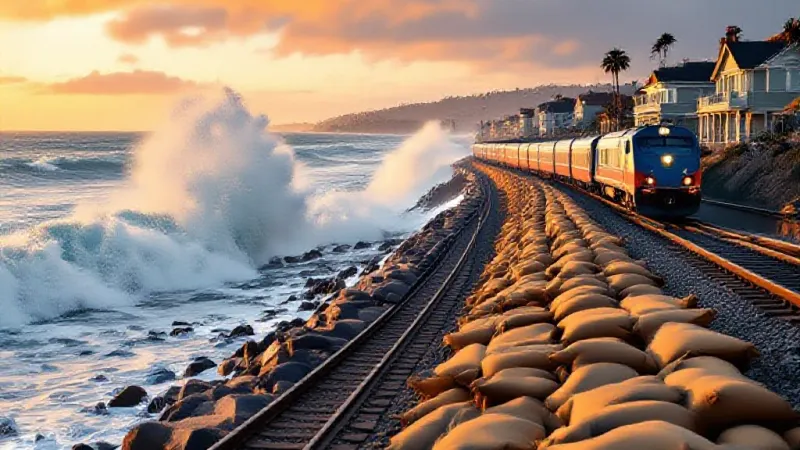
Orange County residents and officials are deploying large rocks and seawalls to protect coastal homes and a critical railroad line as strong El Niño-fueled waves continue to batter California's shore. However, this defensive strategy is raising concerns that it could damage the state's iconic sandy beaches. Jonathan Warrick, a research geologist with the U.S. Geological Survey, described these measures as a “double-edged sword,” noting that while they may offer short-term benefits, long-term studies indicate potential negative effects both at and near the site of implementation.
The debate between immediate coastal protection and its lasting consequences has been ongoing for years, intensified by rising sea levels. With a potentially powerful El Niño predicted for winter, this tension is now reaching a critical point. While experts suggest that rocks and seawalls might protect coastal infrastructure this year, the effects on the coastline could extend well beyond the current storm season.
California's shoreline features numerous man-made barriers, including rocks, seawalls, concrete, and wood, all designed to guard against the elements. These “hardening the coastline” tactics are gaining urgency as the Pacific, churned by El Niño, causes erosion described as unprecedented in recent times. In Dana Point, homeowners on Beach Road, within the Capistrano Bay Community Services District, have been rapidly installing protective measures like boulder barriers, as stated by the city. KTLA-TV recently showed footage of workers applying concrete near the shore to shield beachside homes from high surf.
A vital coastal railroad line, carrying $1 billion in freight annually, has faced the risk of collapsing into the ocean for years. Despite a project to install large boulders, known as riprap, between the tracks and the sea—set for completion in 2025—sediment adjacent to the train tracks was observed falling into the ocean just this month.
While these coastal hardening efforts may provide short-term protection for man-made structures, they are also accelerating the loss of California’s beaches. Sandy stretches are increasingly caught between a rising ocean and seawalls. The U.S. Geological Survey in 2017 projected that California could lose up to two-thirds of its beaches by the century's end if sea levels rise by 3 to 6 feet. A sandy coastline can naturally adapt to rising sea levels by moving inland. However, constructing a seawall or other barrier creates an unyielding line, leaving no room for the sand to retreat. Chad Nelsen, chief executive of the Surfrider Foundation, stated that these barriers “ultimately destroy the beach,” emphasizing that a trade-off is being made between protecting property and public beach access.
Erosion is already significantly altering popular beaches from Carlsbad to Santa Cruz. Experts studying the coastline have long anticipated this conflict between public beaches and coastal property owners. Cities like Pacifica, near San Francisco, have experienced this dilemma acutely, where a beach present in the 1970s has been largely replaced by an armored coastline. Even with such defenses, cliffs eroded to the point where precarious apartments had to be demolished.
Importing sand to replenish eroding beaches offers a partial solution for some areas, but it comes with a substantial cost. Mr. Nelsen questioned the fairness of using state and federal funds for beach replenishment, effectively providing “free public protection” for homeowners at taxpayer expense. He suggested that at some point, purchasing homes might become more economical than perpetually funding beach nourishment projects, which can cost “tens of millions of dollars.”
In Dana Point, the California Coastal Commission approved 24 emergency permits on Beach Road this month, primarily for constructing new rock revetments protecting two dozen homes, according to spokesperson Joshua Smith. Mr. Smith noted the Commission has consistently engaged the community and city on long-term strategies for flood prevention, suggesting options such as cobblestone berms, elevated homes, and sand replenishment. He also cautioned that while seawalls offer temporary relief, they can “increase erosion and destroy the public beaches” that inherently protect coastal structures. The Commission also highlighted that all 201 parcels on Beach Road face a high risk of flooding, based on Federal Emergency Management Agency flood insurance maps. They observed that many damaged properties had older, unpermitted wooden seawalls insufficient for the severe wave action and erosion recently witnessed. Shoreline hazards in the area have been recognized since the 1960s, but homes built then were not initially designed to withstand them, the Commission stated. Following the California Coastal Act in the 1970s, new and redeveloped homes have been mandated to be elevated and designed to resist erosion and flooding, thereby “discouraging seaward encroachment.”
The debate over seawalls also impacts the vital coastal rail route linking Orange County to San Diego County through San Clemente. Since 2021, the route has endured “coastal erosion, bluff movement, landslides, high tides, storms and powerful ocean swells,” leading to nearly a full year of service disruptions, according to the Orange County Transportation Authority (OCTA). California has declared a statewide emergency in anticipation of a severe El Niño winter. OCTA reports it is developing solutions to safeguard the rail line for the next three decades, while a separate state-led initiative will address longer-term solutions. Proposed concepts include sand placement and, depending on the location, more robust engineered solutions like seawalls or rock. The authority stated that “More than $300 million in state, federal and local funding has been secured” for these rail protection efforts, with sand placement being a key element. Orange County Supervisor Katrina Foley, an OCTA board member, conceded that while rocks are not ideal, they are frequently the only recourse during emergencies. Supervisor Foley acknowledged that the continuous addition of rocks worsens sand erosion, but affirmed they are necessary “to protect the rails.” She also noted that large-scale sand projects typically require years for approvals, permitting, and coordination with federal agencies, expressing hope for expedited processes. Following a local emergency declaration this month, Orange County officials advanced a project to move 200,000 cubic yards of sand.