
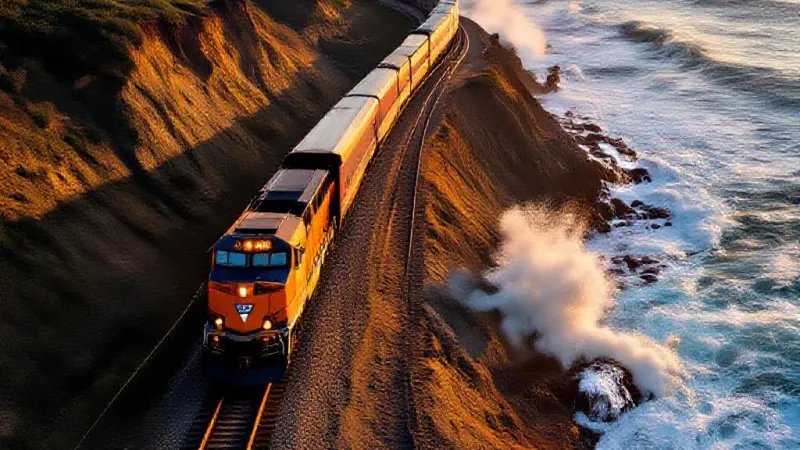
The vital railroad line traversing the San Clemente coast is facing increasing threats from rising seas and strong surf, leading to discussions about its future. Transportation experts have long considered the possibility of moving the tracks in the area. The California State Transportation Agency is anticipated to initiate a study before the end of the year to investigate the requirements for potentially relocating the rail line, according to Darrell Johnson, chief executive of the Orange County Transportation Authority (OCTA).
Mr. Johnson stated that the study is expected to span at least several months. Previous estimates from transportation planners suggested that moving the tracks inland could cost more than $5 billion. Coastal Orange County has experienced repeated shutdowns of rail sections due to landslides, erosion, and rockfalls, with another stormy winter approaching.
Regarding the upcoming study, Mr. Johnson remarked, “It will be complex. It will be expensive. It will be long-term in nature.” He expressed satisfaction that the state of California is expected to launch the study later this year, anticipating significant public engagement and an examination of options to address current challenges.
The stretch of track along the San Clemente shoreline is officially known as the LOSSAN Corridor, short for Los Angeles-San Diego-San Luis Obispo. It provides passengers traveling between Los Angeles and San Diego with scenic views of sandy beaches and the ocean. However, landslides, coastal erosion, and rockfalls have consistently jeopardized the line's stability over the years.
In September, high tides and powerful waves from Hurricane Marie caused further erosion and slope damage near the tracks in San Clemente, temporarily halting Pacific Surfliner and Metrolink service. The California Coastal Commission, as a condition for work on the San Clemente rail line, required a Long-Term Railroad Adaptation Study to be completed by 2034, according to a statement from the California State Transportation Agency.
With California's coast being impacted by strong waves amid a strengthening El Niño, residents and city leaders are using protective measures like large rocks and seawalls to safeguard homes and prevent railroads from collapsing into the sea. The state agency confirmed that the study has not yet begun and that all options remain under consideration. The agency emphasized that no decision has been made to relocate the rail line in San Clemente, stating it would be premature to identify a route, timeline, or cost before the study concludes. Relocating a rail line that serves passenger, freight, and military traffic is described as a major, long-term undertaking requiring careful analysis of engineering, environmental impacts, community effects, cost, and funding, along with close coordination with various partners. In the interim, the agency noted that protecting the existing line is essential to keeping trains running safely for the communities that rely on them.
Over the past five years, coastal erosion, bluff movement, high tides, and landslides have significantly disrupted rail service in San Clemente. More than $300 million in local, state, and federal funding has been directed toward rail protection measures, including sand placement. An El Niño-fueled Kelvin wave is currently approaching the Southern California shoreline, increasing the risk of significant coastal flooding and beach erosion.
Two years ago, the OCTA identified four "significant concern" hot spots along the San Clemente coast requiring repairs. The agency secured state and federal emergency funding for these repairs, but the work is approximately a year and a half behind schedule. Mr. Johnson attributed the lack of sand on beaches to urban development and concrete lining of channels from past years, which have altered sediment and flow patterns. He also noted that sea-level temperatures appear to be rising, leading to an expanded volume of water.
Delays along the rail corridor create "cascading" effects throughout the rest of the system, impacting other agencies due to shared crews and equipment, according to Fiailoa AhSue, assistant director of track and structures maintenance at Metrolink. Ms. AhSue confirmed that Metrolink, which provides commuter rail service across Southern California, will be involved in the relocation study. She stated that their responsibility would be to ensure that any new track is inspected and safe for operations.
OCTA has already completed its own Coastal Rail Resiliency Study, which evaluated strategies to protect the railroad for up to 30 years. A draft of this study proposed 23 different strategies, including bluff stabilization, catchment walls, sand placement, engineered revetments or seawalls, and improvements to the rail foundation. Shannon Vaughn, coastal program manager for the California Coastal Commission, explained that the Coastal Commission requires relocation studies as part of its oversight under the California Coastal Act, a law designed to protect the state’s coastline. The study would identify potential relocation sites and involved state, local, and federal agencies.
Ms. Vaughn noted that the Coastal Commission would only be involved in the rail line's relocation if the track needed to be moved within the coastal zone. A relocation project could also require permits from various other agencies, including the State Lands Commission, State Parks, the U.S. Army Corps of Engineers, or the U.S. Fish and Wildlife Service. She highlighted the complexity of the rail corridor's location in a sensitive area, which results in multiple state agencies having jurisdiction to protect the public resources it crosses.