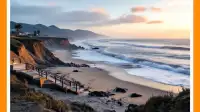

Southern California faces the potential loss of 30 to 70% of its beaches in the coming decades, according to findings from California’s Fifth Climate Change Assessment. The state-commissioned report details expected impacts on various aspects of life, from public health to animal habitats.
The assessment indicates that rising ocean levels and waves crashing farther inland will contribute to coastal erosion. Almost half of all beach cliffs are projected to retreat by 30 to 80 feet by the year 2100. Furthermore, a 1.6-foot increase in sea level by 2060 would leave low-lying coastal areas, including the ports and beaches like Santa Monica, Venice, and Redondo, particularly vulnerable to floods and storms. One estimate suggests 15,000 people in Los Angeles County could be exposed to such conditions.
The report, led by the Governor’s Office of Land Use and Climate Innovation, also updates temperature forecasts, projecting a 4-degree Fahrenheit increase in average temperatures and 50% longer heat waves by mid-century. Farther inland, where temperatures are already highest, even greater warming is expected. For the Los Angeles region, which encompasses Los Angeles and Orange counties, as well as parts of the Inland Empire and Ventura, inland areas are predicted to experience days exceeding 115 degrees by mid-century. San Bernardino, for example, which saw August temperatures peak at approximately 109 degrees this year, is expected to have 120 days a year above 95 degrees, compared to 81 historically.
While the assessment does not anticipate a change in overall average precipitation, it forecasts more skewed and sporadic patterns, leading to more frequent wet and dry years and longer droughts. By mid-century, the state is expected to lose about 40% of its snowpack, a crucial water source from the Sierra Nevada that Southern California relies upon. The city of L.A., which imports most of its water, could see a 7 to 13% reduction in imports by mid-century as other sources also diminish.
Wildfire risks are also expected to increase, with the total area burned annually projected to rise by 50% by mid-century without changes in land management. This effect is anticipated to be strongest in mountain areas, where native chaparral is becoming stressed and replaced by more fire-prone plants. Changes in rainfall and snowfall could create conditions similar to those before past fires, where unusually wet winters fueled plant growth that later became tinder dry.
The report notes that these changes will disproportionately affect vulnerable communities. Many low-income communities of color, due to historical discriminatory housing policies, reside in the hottest inland areas. Currently, one in five people in the Los Angeles region cannot afford to adequately cool their homes, a situation expected to worsen with increasing extreme heat and greater strain on the electric grid.
Abby Edwards, senior deputy director for the Governor’s Office of Land Use and Climate Innovation, acknowledged the difficulty of these findings but expressed optimism. Edwards stated that “The future is not predetermined,” suggesting that the projections clarify necessary decisions. She highlighted current state efforts, including “huge investments in the state in extreme heat,” such as adding shade to bus stops and creating green schoolyards. Many coastal communities have also developed sea level rise plans that include constructing seawalls and planting vegetation to stabilize coastlines. Additionally, work is underway to improve rain and stormwater capture to adapt to changing precipitation patterns.
Edwards concluded by noting that numerous actions can be taken immediately to prepare.