
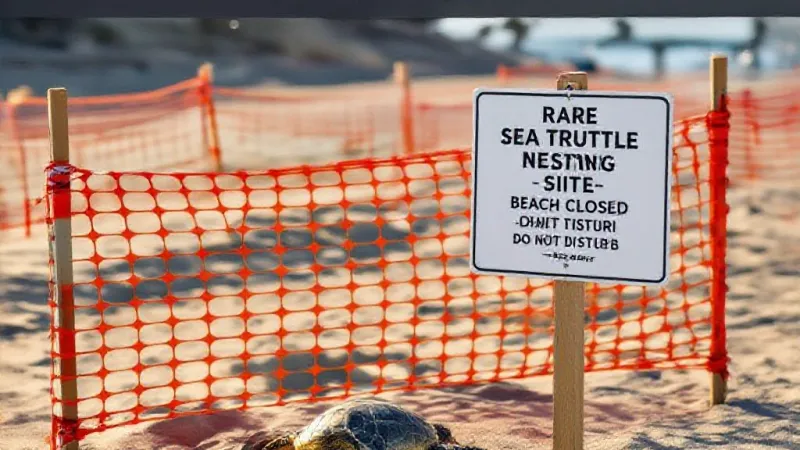
Sections of two Orange County beaches have been closed to the public this week following the rare discovery of a sea turtle laying and burying eggs. The sightings, which experts describe as unprecedented for the species in the United States, have prompted protection efforts in Seal Beach and Huntington Beach.
What is believed to be an olive ridley sea turtle, distinguished by its paddle-shaped paws, was first observed creating a nest and burying its freshly laid eggs in Seal Beach on Wednesday, just yards from the ocean's edge. Three days later, a similar event occurred a few miles south near the Huntington Beach Pier, where possibly the same turtle was seen nesting.
A social media post from NOAA indicated that it remains "unclear at this time, whether this is the same or a different turtle." The agency confirmed that a collaborative team, including local, state, and federal partners, will continuously monitor the nesting sites. The incubation period for these eggs typically ranges from 45 to 60 days, after which baby turtles would embark on their hazardous journey to the sea, according to experts.
Both identified areas have been fenced off and are now protected, featuring interpretive signage to inform beachgoers. NOAA urged the public to maintain a significant distance from these sites and to avoid disturbing the fencing or signage in place.
According to NOAA, olive ridley turtles are recognized as the smallest of the sea turtle species, with adult individuals typically weighing up to 100 pounds and measuring between two and three feet in length. The agency's post also noted that these turtles are estimated to have a lifespan of approximately 30 to 50 years.
Globally, these sea turtles are predominantly found in the tropical waters of the Pacific, Indian, and Atlantic oceans. Major nesting populations in the Pacific region are located in countries such as Mexico, Nicaragua, Costa Rica, and Panama. While olive ridley turtles are occasionally observed in Southern California, typically following warm ocean currents, NOAA explicitly stated that "this species has never been documented to nest in the United States" before these recent events, underscoring the extraordinary nature of the Orange County discoveries.
The public is asked to continue giving nesting sites ample space. For anyone encountering a stranded sea turtle, the NOAA Fisheries West Coast Stranding Hotline is available at 562-506-4315. Additionally, sightings of sea turtles can be reported through the NOAA Fisheries West Coast Facebook account.