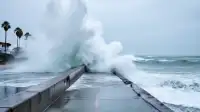

Southern California communities, including those in Orange County, experienced widespread coastal flooding on Monday as exceptionally high tides moved in, with authorities and residents preparing for several days of elevated sea levels.
Water surged from Newport Harbor onto the streets of the Balboa Peninsula, flooding some businesses in the Balboa Fun Zone. In Long Beach, residents reported inundation along Bayshore Beach, Naples, and the Peninsula. Officials in both cities had been actively preparing for the anticipated tides, with crews moving sand, installing sandbags, and working to protect areas vulnerable to recent flooding. Over the weekend, officials urged residents in flood-prone areas to take proactive steps, such as moving vehicles to higher ground and protecting property with sandbags.
In Newport Beach on Monday, crews were engaged in pumping out knee-high water and reinforcing sandbags along the harbor side of the Peninsula. Despite the high tide, city officials had not received reports of significant widespread damage. Georgia Rios, a spokesperson for the city of Newport Beach, attributed this outcome to the community’s adherence to the city’s preparation messages.
“We saw about 25,000 sandbags go this weekend,” Rios stated, noting the community’s strong participation. She indicated that much of the success in avoiding extensive flooding damage was due to residents actively acquiring sandbags for their homes.
Record or near-record tide levels were observed across the region. The San Pedro tide gauge recorded 8.02 feet Monday morning, surpassing the previous record of 7.93 feet from January 2005. In La Jolla, the sea level reached 7.75 feet, close to its record of 7.81 feet set in 2015. Chandler Price, a meteorologist with the National Weather Service in San Diego, noted that even higher tides were expected Tuesday, potentially breaking records.
The National Weather Service has issued a coastal flood warning for Orange and San Diego counties, which will remain in effect through Thursday afternoon, anticipating significant coastal flooding. Low-lying properties, including homes, businesses, and critical infrastructure, are expected to be inundated, and some shoreline erosion is predicted during morning hours. Farther north, counties including Los Angeles and Ventura were under a coastal flood advisory, with isolated damage possible.
This week’s extreme water levels are attributed to a rare combination of factors: an active eastern Pacific hurricane season fueled by El Niño, a marine heat wave, and an astronomical alignment that occurs approximately once every two decades. Total water levels in Los Angeles, Orange, and San Diego counties could exceed 8 feet above the baseline, which is defined as the average daily lowest water level between 1983 and 2001. In Newport Beach, the seawater reached a high of 8 feet on Sunday and 8.3 feet on Monday, with potential levels reaching 8.5 feet on Tuesday and Wednesday.
Scientists report that record-hot ocean-water temperatures off California are contributing to seawater levels being 1.25 to 1.8 feet higher than what would be expected solely from lunar and solar movements. These ocean temperatures are influenced by human-caused climate change, an El Niño-fueled Kelvin wave, and a separate marine heat wave. Experts warn that coastal flooding is expected to worsen this year and into next, with even higher “king tides” anticipated around the Thanksgiving, Christmas, and Martin Luther King Jr. Day holidays. These upcoming king tides are projected to be exceptionally extreme due to the near-peak alignment of 18.6-year lunar node and 4.4-year lunar perigee tidal cycles, according to Reinhard Flick, a researcher at the Scripps Institution of Oceanography at UC San Diego. Scientists caution that if significant storms coincide with these holiday king tide events, the risk of coastal flooding will further intensify.