
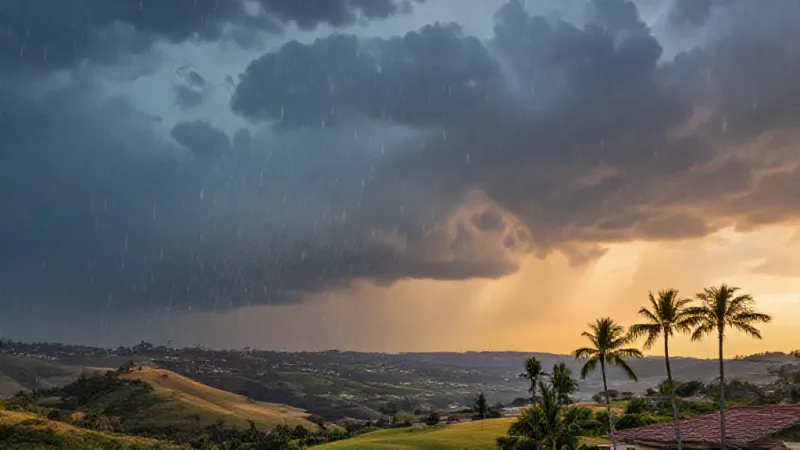
California is virtually certain to experience a “super” El Niño, prompting officials across Southern California to prepare for a potentially wet and challenging winter. Local authorities are actively working to secure hillsides and ensure flood control systems are operational before the anticipated rains arrive.
Forecasters indicate a 75% probability that this El Niño will be stronger than any seen since 1950. The National Oceanic and Atmospheric Administration’s Climate Prediction Center further notes a 98% chance that the pattern will be “very strong” for the three-month period concluding in December. Weather experts suggest this climate pattern, characterized by warmer ocean waters in the central and eastern tropical Pacific, could direct a powerful stream of tropical moisture towards Southern California, leading to significant rainfall.
Los Angeles officials are “actively planning” for the super El Niño, according to a statement from Mayor Karen Bass’ office. City staff regularly consult with the National Weather Service and are focusing on reinforcing burn scar areas to lessen the impact of debris flows, flooding, and high winds. Additionally, L.A. County has undertaken extensive sediment removal from reservoirs, including San Gabriel, Eaton Wash, and Devil’s Gate, to enhance their water-catching capacity and prevent floods.
While no preparation guarantees absolute protection, experts emphasize that beginning preparations before storms hit is essential to reducing risks for homes and on the roads. L.A. County Supervisor Lindsey Horvath urged county residents to enroll in emergency alerts and to understand specific risks in their areas, especially if living near hillsides, canyons, recent burn areas, or flood-prone locations. She also advised making an evacuation plan.
For homeowners, Terry Heller, owner of Southern California roofing company Preferred Roofing, recommends scheduling a roof inspection if a home has experienced previous leaks or if its roof is more than 12 years old. Heller noted that routine maintenance can prevent emergencies, such as a leak appearing during a heavy storm when roofers might be overwhelmed with calls and only able to offer temporary solutions like tarping. He stressed the importance of consulting a licensed roofer for safety and advised verifying licenses on the California Contractors State License Board website, ensuring the license holder’s name matches the company’s listed owner. Checking online ratings and asking for neighborhood references are also suggested.
Landscape architect Esther Margulies, who directs USC’s graduate programs in landscape architecture and urbanism, advises inspecting water flow in yards. She suggests ensuring all drains are clean, unobstructed, and discharge water to its intended destination, typically a curb drain. Testing drains with a garden hose can confirm water emerges correctly. If water accumulates or crawl spaces are consistently damp, installing a sump pump should be considered. Margulies also pointed out that for smaller properties, problematic water often comes from the roof. She recommends placing rain barrels at downspout points to capture this concentrated flow, noting that 80- to 100-gallon barrels fill quickly and the stored water can be used for irrigation after storms. For recurring ponding issues, Margulies suggests increasing permeable areas by aerating compacted lawns and, in some cases, reducing unnecessary paving to allow water to infiltrate and recharge groundwater.
Sandbags can serve as a last-resort measure to redirect water flow, especially if it is building towards a door or other openings. They should be stacked in rows as a barrier. L.A. County provides a map of free sandbag distribution sites, encouraging residents to call ahead and show proof of residency.
Tree care is another critical step. Santa Monica arborist Alison Lancaster recommends hiring a licensed consulting arborist for an independent evaluation of structural issues like cracks, weak attachments, and decay, as well as for targeted pruning recommendations. Lancaster cautions against tree thinning, which involves indiscriminately removing interior branches, and tree topping, which reduces large branches to stubs, as both practices stress trees and can compromise their safety. When hiring, she advises selecting a qualified contractor with a current state license, insurance, and an arborist certified by the International Society of Arboriculture on staff. Acting quickly is advisable, as consultants and contractors often become fully booked this time of year. For palm trees, professionals should remove dead fronds before storms, as these can blow off in high winds, causing damage or striking power lines.
Beyond structural preparations, environmental stewardship during rainy periods is crucial. Margulies emphasized securing items like fertilizer bags and open paint cans to prevent them from washing into storm drains, which lead untreated to rivers, streams, and bays. For sloped yards prone to runoff, planting ground cover such as buckwheat and coyote brush can create a protective carpet over the soil, slowing water flow. While plants established in September may not offer immediate erosion control, they will be beneficial in the long term, according to Lancaster. Additionally, it is a key pre-El Niño reminder to turn off automatic watering during rainy periods.
On the financial front, attorney Amy Bach, executive director of United Policyholders, a San Francisco consumer group, suggests obtaining a flood insurance quote. She notes that many people incorrectly believe they do not need flood insurance unless they live near a body of water, but warns that climate change is increasing vulnerability to flooding from severe convective storms. Bach also advises reviewing home insurance policies, as coverage details, particularly for water damage and payout caps for water-related repairs, may have changed. Understanding deductibles is important, and Bach generally counsels against filing small claims for losses that can be afforded out of pocket, as such claims might appear on a record and potentially raise future premiums. To simplify potential claims, Bach recommends documenting valuables by recording a video walkthrough of each room with a narration, including high-value items in drawers and closets, and emailing the video to oneself for a secure copy.
Finally, Redd advises having a trusted mechanic inspect your car, noting that "a little preparation now can go a long way."