
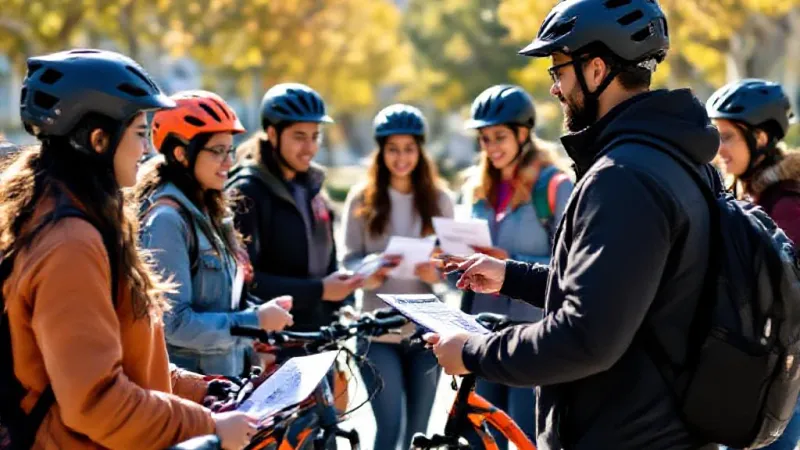
Orange County agencies and community partners are increasing efforts to inform students and families about the safe operation of e-bikes and other electric two-wheelers, which have become increasingly common in local neighborhoods and near schools.
The initiative, known as the E-Bike Injury Prevention Collaborative, was launched in 2024 and is jointly hosted by the Orange County Department of Education (OCDE) and the Orange County Health Care Agency. This countywide collaboration unites hospitals, law enforcement, schools, and other community groups to focus on education, injury prevention, and coordinated action to enhance safety.
Dr. Stefan Bean, County Superintendent of Schools, recently emphasized the critical importance of prevention and awareness. Speaking at an e-bike safety event organized by the county District Attorney Todd Spitzer’s office at Angel Stadium, Dr. Bean highlighted potential risks. “We’ve seen how quickly an e-bike can become a serious safety issue when a young rider doesn’t understand the speed, the rules or the capabilities of the device,” Dr. Bean stated. He further explained that Orange County has adopted a collaborative strategy, involving schools, health professionals, law enforcement, and families, to concentrate on prevention and education. The goal is to ensure families comprehend their purchases, young riders know safety rules and best practices, and that they have the necessary information for sound decisions and safe returns home.
California law defines an electric bicycle as having fully operable pedals and an electric motor under 750 watts. State law categorizes e-bikes into three classes:
* **Class 1:** Provides motor assistance only while the rider pedals, with assistance cutting off at 20 mph. * **Class 2:** May utilize a throttle, with motor assistance cutting off at 20 mph. * **Class 3:** Offers pedal assistance that cuts off at 28 mph.
Under California law, riders under 18 are required to wear a helmet when operating any bicycle, including e-bikes. All operators of Class 3 e-bikes must wear a helmet, regardless of their age.
It is also important for families to recognize that some higher-powered electric two-wheelers, despite resembling e-bikes, may not meet California’s legal definition and could fall under different legal categories with distinct requirements. This makes understanding a device's specific classification crucial beyond its appearance or marketing.
Dareen Khatib, OCDE’s senior administrator for Health, Safety and Prevention, stressed the importance for families to understand the specific device a young person is riding. Ms. Khatib noted that differences in speed, power, and operation significantly impact safety, and the aim is to help families ask appropriate questions, understand regulations, and ensure young riders possess the knowledge and skills for safe riding.
While state law establishes fundamental e-bike classifications and requirements, families must also be aware of local rules that govern where and how these devices can be operated. For instance, in Newport Beach, city regulations mandate that e-bike riders travel at reasonable speeds, obey traffic signs and signals, yield when required, and avoid unsafe behaviors such as riding against traffic or weaving through pedestrians. Newport Beach also restricts electric bicycles on specific recreational trails.
This highlights that rules applicable in one Orange County community—particularly concerning sidewalks, trails, or parks—may differ in another. Families are encouraged to consult their city or local law enforcement agency for rules specific to areas where their children ride.
OCDE's objective is not to endorse or discourage e-bike ownership but to provide students and families with accurate information about their devices and how to operate them responsibly. Parents can begin by identifying their child’s device type, understanding its capabilities and speed, checking local rules, and discussing helmet use, traffic laws, and safe riding practices with young riders.
Dr. Bean emphasized that there is no single solution to e-bike safety. He stated that it requires education, responsible choices, thoughtful enforcement, and communities working together. The broader aim, he concluded, is to help young people make informed decisions and return home safely.