
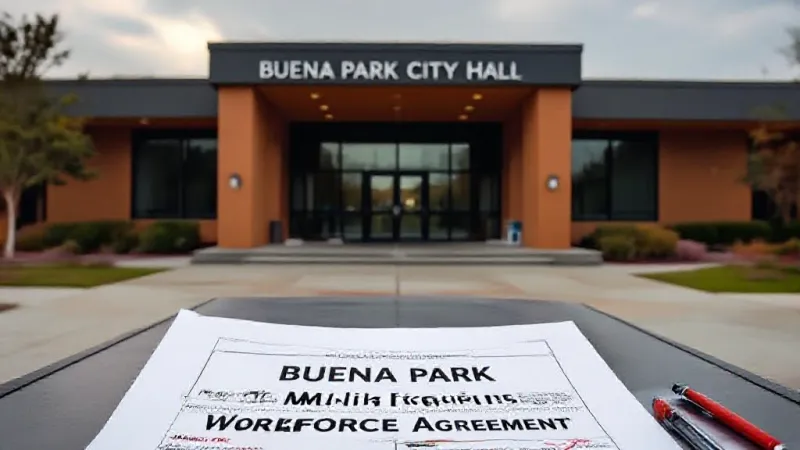
Buena Park's implementation of a Community Workforce Agreement (CWA) for city construction projects has drawn scrutiny, with critics asserting that the policy has led to wasted taxpayer dollars. Concerns have been raised that the agreement, pushed by Mayor Connor Traut, overcharges the public for construction by creating what some describe as no-bid, sole-source labor contracts. These “deals” are further criticized for allegedly discriminating against a large portion of local construction workers and increasing project prices.
The source material points to an instance in 2022 where a project labor agreement (PLA), a precursor to the CWA, was pushed by then-Mayor Traut and reportedly cost City of Buena Park taxpayers over a half-million dollars in overruns on a single project, benefiting what critics describe as his political donors. The name of the agreement was reportedly changed from “Project Labor Agreement” to “Community Workforce Agreement,” which some suggest was an attempt to obscure the nature of the special interest deal.
On March 8, 2022, the City Council approved the CWA between the City of Buena Park and the Los Angeles and Orange Counties Building and Construction Trades Council. This agreement has a five-year term, effective from July 1, 2022.
Warnings about the potential financial impact of such an agreement were voiced early on. Eric Christen from the Coalition for Fair Employment in Construction, for example, wrote to Mayor Traut and other Buena Park councilmembers, stating that the city would be “stuck with this disaster until 2027,” further noting that this “canine affection for big labor special interests” would cost taxpayers “tens of millions of dollars.” Industry associations, including the Western Electrical Contractors Association and the Coalition for Fair Employment in Construction, had reportedly cautioned Buena Park about the implications of a Project Labor Agreement for taxpayers.
Local labor bosses, on their website as recently as February 12, 2025, specifically credited Mayor Traut's leadership, stating that, “In Buena Park, we saw firsthand the difference that Connor Traut made as a councilmember and mayor. With his leadership, the City of Buena Park entered into its first Community Workforce Agreement for infrastructure projects.”
In response to ongoing challenges, the Buena Park City Council scheduled an “Update on the City’s Implementation of the Community Workforce Agreement” in November 2023. Prior to this, City staff met with local union representatives to review administrative “challenges” faced by the City under the CWA. The staff review highlighted difficulties in receiving an adequate number of bids for projects, primarily attributed to contractors’ unwillingness to abide by the CWA. This issue was particularly noted for projects requiring specialty work, such as pool or park improvements, and for soliciting professional services like geotechnical engineering and surveying.
Subsequent incidents further underscored these challenges. In April 2024, the Buena Park City Council was compelled to reject all bids for the Smith Murphy Park and Carl Brenner Park Accessibility Improvement Project, which has since been renamed Friendship Park and Carl Brenner Park. Six bids were received for the project on March 28, 2024, ranging from $1,012,847 to $1,779,240. With the project budgeted at $800,000, these bids were between 30% and over 120% above the estimate, prompting staff to recommend rejecting all of them.
Another incident occurred in July 2024, when a City of Buena Park project received only one bid, which was 59% over the engineer's estimate of $690,000, totaling $1,099,628. This sole bidder was also deemed unqualified.
The source material indicates that these difficulties—including higher bids, fewer bids, and problems in attracting qualified contractors—are clear signs that the city has faced significant challenges in receiving an adequate number of bids, largely due to contractors' reluctance to adhere to the CWA. Critics argue that by implementing the CWA, Mayor Traut codified discrimination into city policy, making it difficult for Merit Shop construction workers, apprentices, and contractors—who reportedly comprise 90% of the local construction workforce—to participate in city projects. The agreement, lacking an out clause, is set to remain in effect until 2027.