
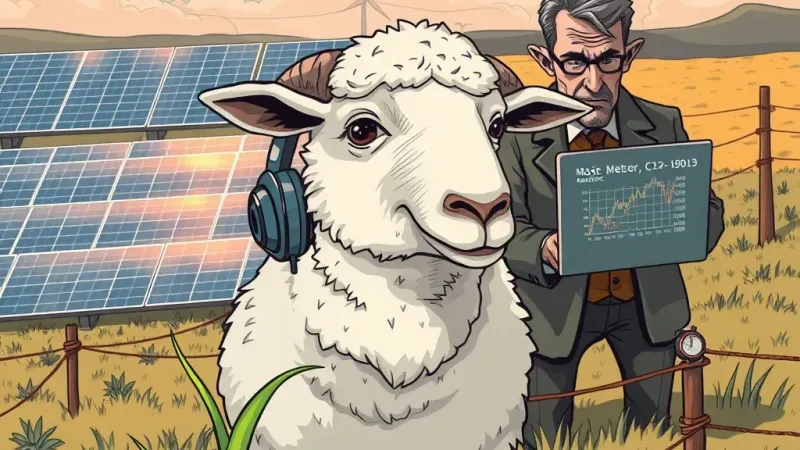
ITHACA, NY—In a breakthrough that bridges the gap between massive corporate energy portfolios and the timeless art of four-legged lawnmowers, a new Cornell University study has confirmed that sheep forced to graze beneath multi-million-dollar solar arrays are experiencing unprecedented levels of economic viability, provided they do not attempt to unionize or demand dental benefits.
The research, published this week by agricultural economists who clearly have too much grant money and not enough actual grass to touch, reveals that co-locating livestock with photovoltaic infrastructure creates a synergistic ecosystem where capital gains comfortably intersect with digestive tracts. For years, energy conglomerates faced a brutal dilemma: how to keep noxious weeds from blocking the sun-gathering silicon without paying human beings a living wage and providing a standard benefit package. The answer, as it turns out, is to outsource vegetation management entirely to wool-bearing proletarians who accept payment exclusively in clover, shade, and the faint hope of not being turned into chops before autumn.
To streamline this brutal late-stage pastoralism, the university’s top minds developed a proprietary "decision-support tool." This state-of-the-art software algorithm allows agribusiness operators and venture-backed green energy startups to meticulously calculate the exact cost-per-calorie ratio of a ewe chewing on a dandelion while a massive corporate tax write-off hums six feet above its woolly head. No longer must farmers guess how many ruminants are required to prevent a clean-energy infrastructure project from getting overgrown by local brush. The app tells them instantly, factoring in wind speed, solar yield degradation, and the animal’s current psychological distance from the slaughterhouse.
"We are looking at a profound paradigm shift in how we extract value from agricultural real estate," said lead researcher Dr. Arthur Vance, adjusting his glasses while staring blankly at a proprietary spreadsheet that measures animal dignity strictly in kilowatt-hours. "Before our decision-support tool, farmers were operating in the dark. They would just put a sheep in a field and hope it ate the grass. It was barbaric, inefficient, and utterly lacking in predictive analytics. Now, we can algorithmically determine the exact breaking point of a ram's knees before productivity dips. It is pure, unadulterated science meeting the free market."
The study further notes that beneficial insects are also thriving within these fenced industrial microclimates, offering a delightful secondary narrative that corporate public relations departments can instantly weaponize for their upcoming ESG reports. Bees, beetles, and various crawling horrors now have a shady, metal-roofed sanctuary to populate beneath panels manufactured in overseas facilities with entirely separate human rights violations. It is a truly closed-loop system of absolute corporate harmony. The sun hits the panel, the panel powers a data center training an AI model to replace local journalists, the shade grows the grass, the sheep eats the grass, and the farmer receives a modest federal subsidy check that still fails to cover the cost of a tractor tire.
Industry experts predict that within five years, every major electrical grid in the nation will be entirely maintained by exhausted livestock running on subscription-based firmware, finally bringing America's ancient pastoral traditions into violent, flawless alignment with quarterly shareholder expectations.