
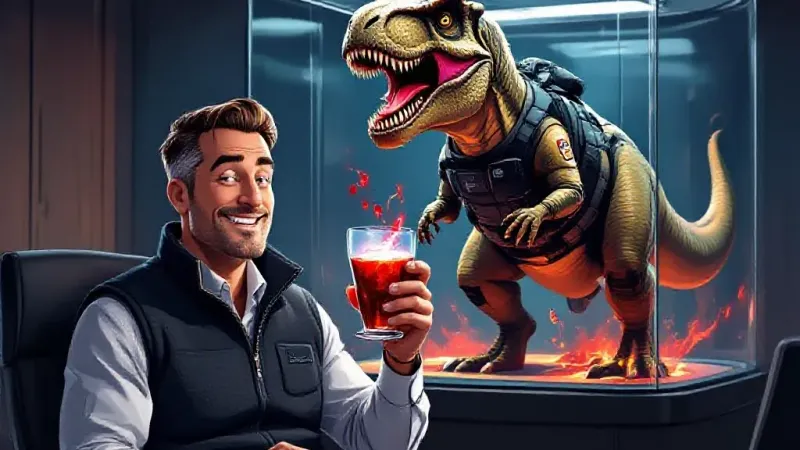
PALO ALTO, Calif. — Within minutes of Brazilian paleontologists announcing the recovery of pristine, 3D red blood cells from a 115-million-year-old Aratasaurus fossil, venture capitalist Peter Vance bought the mineral rights to the entire excavation site, the laboratory processing the bone, and the living descendants of the original research team.
According to SEC filings submitted early Tuesday morning, Vance’s newly minted defense startup, Apex Apex, has already burned through $4.2 billion in seed funding to construct a high-containment breeding facility in an undisclosed offshore tax haven. The objective is simple: stop paying human private security guards who demand healthcare and instead deploy 20-foot theropods bound by genetic conditioning and asset-tier NDAs.
"Human bodyguards are an outdated equity drain," Vance said in a webcast broadcast from his private bunker, holding up a glass vial containing a single drop of brown sediment. "They ask for stock options. They have families. They get traumatized when a drone swarm flies overhead. A revived Cretaceous apex predator doesn't care about work-life balance. It has one core competency: territorial hyper-aggression. That’s pure alignment of incentives."
The discovery of preserved soft tissue in the Aratasaurus leg bone was initially hailed by the international scientific community as a monumental breakthrough for evolutionary biology. However, before the original paper could even be indexed in academic journals, Silicon Valley tech leaders had already commodified the prehistoric specimen into a series of speculative bio-assets.
Leaked internal slacks from major tech firms show executives already debating the tactical advantages of different extinct species. While smaller tech founders are reportedly settling for velociraptor packs to handle gatekeeping at founder retreats, tier-one tech executives are holding out for full-scale sauropods equipped with rooftop surveillance arrays.
"The current paradigm of hiring former Delta Force operators is wildly inefficient," said Apex Apex Chief Scientist Dr. Marcus Finch, who previously ran synthetic biology programs before being offered a package that included equity in the Mesozoic Era. "A human security agent has a reaction time of roughly 200 milliseconds. An Aratasaurus running at top speed doesn't need a reaction time because it is simply an engine of kinetic violence. When a trespasser approaches Mr. Vance’s estate, we won't need to issue a warning. The warning is the 4,000 pounds of crushed bone and roaring."
Ethicists have pointed out that the Aratasaurus was a bird-like theropod that hunted small reptiles, raising questions about its effectiveness against modern automatic weapons. Vance’s team dismissed these concerns, noting that the resurrected dinosaurs will be retrofitted with Kevlar body armor and fed a proprietary diet of soy protein and disrupted competitors.
As of press time, the Federal Aviation Administration was already reviewing an emergency permit application to allow non-feathered prehistoric carnivores to patrol low-altitude airspace surrounding gated communities in Atherton.
"People ask me if Jurassic Park taught us nothing," Vance added, leaning into his camera. "Jurassic Park failed because of poor middle management and a lack of proper equity incentives for the IT staff. Under our governance model, the dinosaurs will be fully vested after four years. It’s basic economics."