
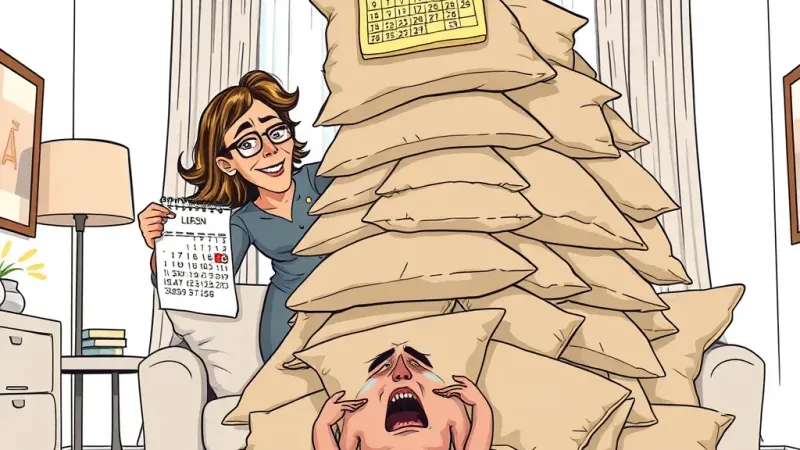
Millions of design-conscious Americans woke up to a terrifying realization this morning: the neutral-toned, driftwood-accented sanctuary they spent forty grand curating to look like an upscale airport lounge is actually aggressively boring. According to a grim dispatch from the aesthetic command center at Apartment Therapy, your relentless pursuit of a timeless home has instead trapped you inside a beige holding cell where joy goes to die. The concept of timelessness, long marketed as a noble escape from the frantic cycles of fast fashion, has revealed itself to be what it always was: an even more insidious consumer trap that demands you continuously buy new garbage just to prove your appreciation for antiquity.
The core tragedy of the modern timeless movement is its terrifying commitment to absolute lack of offense. To achieve timelessness, a home must be stripped of any color, texture, or artifact that might suggest a human being with thoughts, memories, or untreated trauma actually lives there. Instead, your living room must feature a distressed oak coffee table imported from a forest that was clear-cut last Tuesday, topped exclusively by three ceramic vases that cost more than a root canal and hold nothing. If your guests can identify your political affiliation, your favorite food, or the fact that you occasionally feel sadness, you have failed the aesthetic test. You are required by cultural law to live inside a showroom for a high-end Scandinavian bank.
Design experts point out that the main mistake homeowners make is assuming that because a style has survived for three hundred years, it should also survive your toddler running through the drywall with a juice box. This fundamental misunderstanding of history is why suburban living rooms across the nation currently resemble the waiting room of a deeply depressed divorce attorney. We are told to invest in heirloom pieces, which is modern developer-speak for particle board wrapped in a thin veneer of overpriced sadness that will disintegrate the moment humidity hits forty-two percent. You bought the linen sofa because it looked effortless in the digital brochure, failing to account for the harsh physical reality of gravity, bodily fluids, and the relentless march of entropy.
The remedy, naturally, is to spend more money buying different neutral items to replace the neutral items you bought last year. If your home looks static, it is because you have not updated your collection of decorative pampas grass to reflect the changing geopolitical landscape. Experts recommend swapping out your matte black fixtures for brushed brass, which will instantly transform your living space from a sterile corporate lobby into a slightly warmer sterile corporate lobby. By continuously reinventing the exact same shade of taupe, you participate in the great American tradition of mistaking consumption for identity.
Ultimately, the obsession with a timeless home is a desperate psychological hedge against our own terrifying mortality. If you can just arrange enough minimalist stoneware and matte-black picture frames in a strictly symmetrical grid, perhaps death itself will look at your living room, assume you are already a corporate asset, and simply pass you by. Until then, you can take comfort in knowing that your investment in artisanal burlap will look just as profoundly depressing to the next generation as it does to you today.