
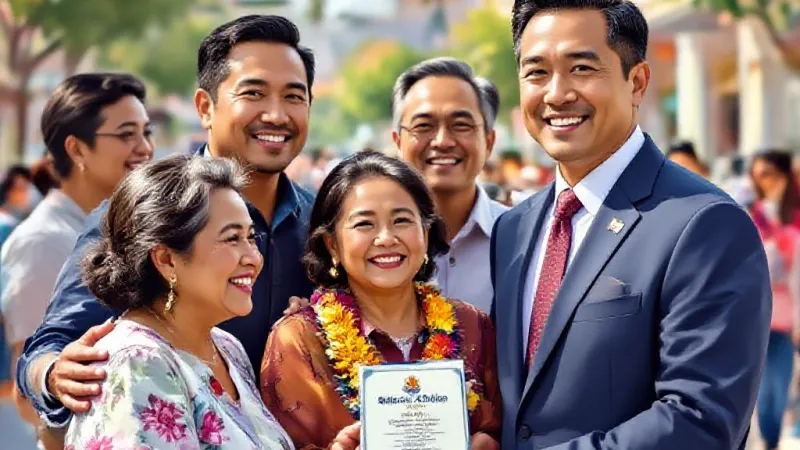
The City of Santa Ana is marking Filipino American History Month by illuminating the Downtown Orange County water tower in the colors of the Philippine flag, acknowledging the significant contributions of Filipino Americans to Santa Ana, Orange County, California, and the nation.
Filipino American History Month, observed each October, commemorates the arrival of the first recorded Filipinos in what is now the United States in October 1587 along the California coast. This makes the Filipino American experience one of the country’s oldest Asian American histories.
For Santa Ana, this recognition holds particular meaning, as the city is home to an active and growing Filipino American community that has shaped healthcare, education, business, public service, and civic life. Among those serving today is Santa Ana City Councilmember Phil Bacerra, who is currently seeking re-election this November.
Councilmember Bacerra's family history connects directly to a crucial chapter in California labor history. In a recent post recognizing Filipino American leader Larry Itliong, Bacerra reflected on his family’s involvement in the labor movement. He noted that Itliong, alongside Philip Vera Cruz, led Filipino farm workers in walking off farms to demand wages equal to the federal minimum wage, an event known today as the Delano Grape Strike.
According to Bacerra, Mexican farm workers joined the effort one week after the Filipino workers began the strike, eventually uniting to form the United Farm Workers of America. After years of organizing, marches, and nationwide boycotts, the workers secured contracts that included higher wages, healthcare, and improved working conditions. Bacerra expressed pride that his grandfather knew Itliong and was involved in these accomplishments.
This history highlights that Filipino American farmworkers were instrumental in launching the movement that ultimately transformed conditions for agricultural laborers across the state. Historians credit Larry Itliong as one of the key leaders of the Delano Grape Strike, working initially with fellow Filipino American labor organizer Philip Vera Cruz and later with César Chávez and the United Farm Workers.
Orange County’s Filipino American community has roots stretching back more than a century. Historians have documented Filipino laborers working in the county’s agricultural economy during the 1920s and 1930s, including in citrus groves, bean fields, and other farming operations in communities such as Fullerton, Anaheim, and Huntington Beach. Over subsequent decades, the community expanded through military service, education, professional careers, and family-based immigration. Today, Orange County is home to one of the largest Filipino populations in the United States.
Organizations such as the Filipino American National Historical Society Orange County and Inland Empire Chapter continue to preserve the stories of Filipino farmworkers, veterans, business leaders, educators, and community activists whose efforts helped shape the county.
Many Filipino immigrants initially found work in agriculture. Others settled in urban centers, establishing community institutions and businesses despite facing discrimination and barriers to economic opportunity. Over time, Filipino Americans became prominent in the military, education, healthcare, engineering, technology, entrepreneurship, and public service sectors, contributing to California’s economic growth and cultural diversity.
One of the most visible ways Filipino culture has become woven into the fabric of Orange County is through its thriving restaurant scene. From traditional family-run eateries to modern chefs offering contemporary spins on classic dishes, Filipino cuisine has become an important part of Orange County’s diverse culinary landscape. Local diners and reviewers frequently praise these establishments. For many local families, these restaurants serve as cultural gathering places where traditions, language, recipes, and community connections are passed between generations.
Few professions are more strongly associated with Filipino Americans than nursing. Due to historic educational ties between the United States and the Philippines, generations of highly trained Filipino nurses have entered the American healthcare workforce. Experts estimate that roughly 150,000 Filipino nurses have immigrated to the United States since 1960, and about one in twenty registered nurses nationwide was trained in the Philippines. Filipino Americans comprise a disproportionately large share of the nursing workforce, making them indispensable to healthcare systems throughout California and the nation. Orange County’s strong network of Filipino healthcare professionals continues that tradition today through organizations such as the Philippine Nurses Association of California Orange County.
While nursing remains a strong association, the community has excelled across numerous industries, with significant representation in engineering, information technology, accounting, government service, and the military.
Santa Ana’s recognition of Filipino American History Month serves as a reminder that the Filipino American community has shaped California in countless ways. From farmworkers who launched a significant labor movement to nurses caring for patients across the state, Filipino Americans have left an enduring mark on California society. The story is particularly relevant in Santa Ana, where Filipino Americans continue to contribute as business owners, educators, healthcare workers, community leaders, and elected officials.